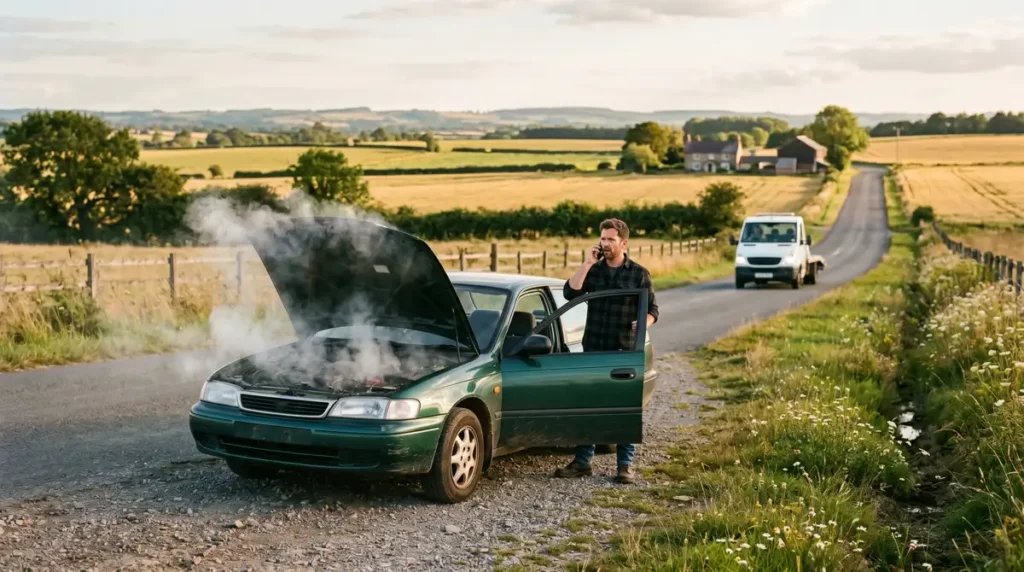
Breaking down on I-40 can be stressful, especially with fast-moving traffic and limited shoulder space. Whether you’re commuting through Lebanon, heading toward Mt. Juliet, or traveling east near Carthage, knowing what to do in the first few minutes can make a significant difference in your safety. Staying calm and following basic roadside steps helps reduce risk while you wait for assistance. These breakdown safety steps follow NHTSA road safety guidelines.
The most important priority is getting yourself out of traffic. If your vehicle is still moving, signal and carefully steer toward the right shoulder. Avoid sudden braking unless necessary, and try to position your vehicle as far from traffic lanes as possible. Even a few extra feet away from passing vehicles can improve safety.
I-40 through Wilson County sees heavy commercial and commuter traffic at all hours. Trucks, campers, and high-speed lane changes are constant factors on this stretch of highway. That reality makes it all the more important to know exactly what to do if your car breaks down on I-40 in Wilson County — before it happens. The steps below are what we recommend to every driver we assist on this corridor.
What to Do Immediately When Your Car Breaks Down on I-40
The first 60 seconds after a breakdown are the most critical. Your actions in that window determine how safe the next hour will be. Here’s a quick checklist of what to do the moment you realize your vehicle is failing:
- Don’t panic — stay focused and think through each step
- Ease off the accelerator gradually rather than braking sharply
- Signal right and begin moving toward the shoulder immediately
- Aim for the widest part of the shoulder, well past any merge zones or on-ramps
- Turn on your hazard lights as soon as you’re slowing down — not after you stop
- Put the vehicle in park, engage the parking brake, and stay inside
If you’re near the Lebanon exits on I-40 — including Exit 232 (US-70, Lebanon) or Exit 238 (Hartsville Pike) — you may be able to safely reach an exit ramp and pull fully off the highway. Getting completely off the interstate, even if it means coasting into a gas station or parking lot, is always the safest outcome.
Step 1: Make Your Vehicle Visible
Turn on your hazard lights immediately. This alerts approaching drivers that your vehicle is disabled and gives them time to move over safely. If you have reflective triangles or flares, place them several feet behind your vehicle to increase visibility, especially at night or in low-light conditions.
If it’s dark outside, keep your interior lights off unless necessary, as bright interior lighting can reduce your visibility to oncoming traffic. During bad weather, stay inside your vehicle unless it is unsafe to do so. High-visibility clothing is recommended if you must exit.
Tennessee law — specifically the Move Over Act — requires drivers to change lanes or slow down when passing vehicles stopped on the shoulder with hazard lights activated. But not every driver complies. Maximizing your visibility gives you the best protection against drivers who don’t see you until the last second. If you have road flares or emergency triangles in your vehicle, place them at 50 feet, 100 feet, and 200 feet behind your car to create a graduated warning zone.
Step 2: Stay in a Safe Position
If you’re on a busy interstate like I-40, it’s generally safer to remain inside your vehicle with your seatbelt fastened. Keep the doors locked and wait for professional roadside assistance. Standing between vehicles or walking along the shoulder increases your risk, especially in high-speed zones.
If your vehicle is in a dangerous position and cannot be moved, call 911 to report the hazard before contacting a towing service. Emergency responders can help manage traffic while assistance is on the way.
One thing we see often in Wilson County is drivers standing outside their vehicles at the rear, trying to assess tire damage or check the engine, while traffic passes at 70+ mph just a few feet away. That’s one of the most dangerous positions you can be in on an interstate. Unless your vehicle is on fire or there is another immediate physical danger inside the car, stay inside, keep your seatbelt on, and move to the passenger side if you’re pulled over on the right shoulder. This positions you farther from the traffic lane if another vehicle strikes your car from behind.
Step 3: Call Professional Roadside Assistance
Attempting to fix certain issues yourself on the interstate can be risky. Changing a tire or walking to find fuel along a busy highway exposes you to traffic hazards. Contacting a professional towing and roadside assistance provider ensures the situation is handled safely.
In Wilson County, services such as emergency towing, jump starts, tire changes, fuel delivery, and accident recovery are available 24/7. Professional operators use high-visibility lighting and proper equipment to create a safer working environment around your vehicle.
When you call for help, give the dispatcher as much location detail as possible. On I-40 in Wilson County, reference mile markers when you can see them — they appear on small green signs along the shoulder every tenth of a mile. Also note which direction you’re traveling (eastbound or westbound), the nearest exit number, and any visible landmarks such as overpasses, rest areas, or service roads. This detail gets a truck to you faster and reduces the amount of time you’re stopped on the shoulder.
Common Interstate Breakdown Causes on I-40 in Wilson County
Breakdowns along I-40 often result from overheated engines, flat tires, dead batteries, or running out of fuel. Summer heat can strain cooling systems, while winter temperatures can weaken older batteries. Long-distance travel may also increase the likelihood of tire failure due to wear or underinflation.
Routine maintenance helps reduce breakdown risk, but unexpected mechanical failures can still occur. That’s why it’s helpful to keep emergency contact numbers saved in your phone before you need them.
Based on the roadside calls we handle in Lebanon, TN and across Wilson County, here are the most common breakdown types we see on I-40 and what typically causes them:
- Flat or blown tires: The most common issue. Underinflated tires, highway debris, and heat-stressed rubber are the leading causes. Always check tire pressure before highway travel, especially in summer.
- Dead batteries: Older batteries often fail without warning. Cold nights and extreme heat both accelerate battery degradation. If your battery is more than 3 years old, have it tested before a long trip.
- Engine overheating: Low coolant, a failing water pump, or a clogged radiator can cause temperature spikes on long highway stretches. Watch your temperature gauge. If it climbs into the red, pull over immediately.
- Running out of fuel: More common than most drivers admit. Heavy traffic on I-40 near Nashville increases fuel consumption. Passing through Wilson County eastbound, the next exits with gas stations are well-spaced — don’t rely on a quarter tank.
- Transmission or drivetrain failure: Often shows as slipping gears, grinding, or sudden loss of acceleration. If your vehicle refuses to accelerate at highway speed, get to the shoulder immediately and do not attempt to continue driving.
- Electrical failures: A failing alternator, blown fuse, or electrical short can shut a vehicle down mid-highway. Dashboard warning lights are your first signal — don’t ignore them.
I-40 Wilson County: Specific Hazards to Know
The I-40 corridor through Wilson County has some specific characteristics that affect breakdown safety and response times. Knowing the local geography helps you make smarter decisions when your car breaks down on I-40 in Wilson County.
- Limited lighting: Outside of the Lebanon exits, much of I-40 through Wilson County is unlit at night. This makes hazard visibility more important. If you have flares, use them.
- Heavy truck traffic: I-40 is a major commercial freight corridor. Semi-trucks require much greater stopping distances and create significant wind wash when passing a stopped vehicle. Position your car as far right as possible.
- Weekend and holiday traffic spikes: Traffic volume increases dramatically on holiday weekends, which increases both breakdown frequency and response time. During peak periods, we recommend calling as early as possible.
- Rest areas: There are no rest areas within Wilson County on I-40. The closest westbound rest area is in Davidson County. If you can make it to an exit, the Lebanon area has multiple service roads and commercial areas near the highway where you can pull safely off the road.
- Cell coverage: Coverage is generally good along I-40 through Wilson County, but remote stretches can have gaps. If your call drops, try again or use 511 (Tennessee’s roadside assistance line) to report your location.
After Your Vehicle Is Recovered
Once your vehicle is safely towed or serviced, consider scheduling a full inspection if the issue isn’t obvious. A dead battery might signal charging system problems, and a flat tire may indicate alignment or suspension concerns. Addressing underlying issues early can prevent future roadside emergencies.
Keep a small emergency kit in your vehicle that includes reflective triangles, a flashlight, bottled water, and basic tools. Preparation doesn’t prevent every breakdown, but it improves your ability to handle one calmly and safely.
After we tow a vehicle back to Lebanon, TN or another Wilson County location, we always recommend having a mechanic do a full post-breakdown inspection even if the repair seems straightforward. An emergency roadside tire change is a good opportunity to also check the other tires, brakes, and suspension components. A jump start that gets you moving again doesn’t fix the root cause — you may need a new battery, alternator testing, or charging system diagnosis before you’re back on the road confidently.
What to Keep in Your Car for Interstate Emergencies
Being prepared before your car breaks down on I-40 in Wilson County is the best investment you can make. We put together this list based on what our drivers see most often in the field — the items that make the biggest practical difference when someone is stranded on the shoulder of the highway.
- Reflective warning triangles or LED flares: Far more effective than hoping other drivers notice your hazard lights alone. Place them early and space them out.
- Jumper cables or a portable jump starter: A compact lithium jump starter fits easily in a glove box and can save a 30-minute wait for a service truck.
- Flashlight with extra batteries: Phone flashlights drain battery quickly. A dedicated flashlight is more reliable for nighttime breakdown situations.
- Bottled water: Important both for drinking while you wait and for temporarily addressing minor overheating issues (coolant, not engine block water).
- First aid kit: Basic supplies for minor injuries that may occur during a breakdown or accident.
- Phone charger or power bank: A dead phone in a breakdown situation on I-40 is a serious problem. Keep a charged backup power bank in your vehicle.
- Emergency contact numbers saved: Don’t rely on a quick Google search when you’re stressed and on the shoulder. Save your towing service contact before you need it.
Final Thoughts
A breakdown on I-40 can feel overwhelming, but following simple safety steps protects you and other drivers. Move out of traffic if possible, make your vehicle visible, remain in a secure position, and call professional assistance. Quick, safe action reduces risk and helps you get back on the road with minimal stress.
If you travel frequently through Wilson County, it’s always wise to know who to call before an emergency happens.
We serve the entire I-40 corridor through Wilson County — from the Davidson County line near Mt. Juliet all the way east through Lebanon and beyond. When your car breaks down on I-40 in Wilson County, we can typically have a truck on-scene quickly. If you need accident recovery or standard emergency towing, we’re available around the clock. Don’t hesitate to reach out through our contact page to save our number before you ever need it.
Frequently Asked Questions: Car Breaks Down on I-40 in Wilson County
What should I do first if my car breaks down on I-40 in Wilson County?
The first priority is getting your vehicle safely off the travel lane. Signal right, ease onto the shoulder, and get as far from traffic as possible. Turn on your hazard lights immediately — ideally before you’ve fully stopped. Once parked, stay inside the vehicle with your seatbelt fastened and call for professional roadside assistance. Do not stand near the rear of your vehicle or on the travel side of the road.
Is it safe to change a tire on the shoulder of I-40?
It can be very dangerous. The shoulder of I-40 through Wilson County sees trucks and vehicles passing at 65-75 mph, often very close to the white line. If you are alone, have no safety equipment, or are stopped in a narrow section of shoulder, we strongly recommend calling for a professional tire change service rather than attempting it yourself. A roadside technician has high-visibility equipment and safety protocols that make the job significantly safer.
How long does it take for a tow truck to reach me on I-40 near Lebanon, TN?
Response times vary depending on traffic, time of day, and exact location on the highway. For most calls on I-40 within Wilson County near Lebanon, we aim for a fast response. Giving an accurate mile marker or exit reference when you call significantly speeds up dispatch and routing.
What if I run out of gas on I-40 in Wilson County?
Pull over safely and call for fuel delivery service. Do not walk along the highway to find a gas station — it’s dangerous and unnecessary. A roadside fuel delivery service can bring enough gas to get your vehicle running and get you to the nearest station. It’s a fast, safe, and affordable solution to a common problem.
Can BNI Towing help with accidents on I-40 in Wilson County?
Yes. We provide accident recovery services along I-40 and throughout Wilson County. If you’ve been in a collision and need your vehicle recovered from the highway, we have the equipment to handle it safely. Call us directly or ask the responding officer to contact us — we work closely with local emergency services in the Lebanon, TN area.